What’s the Real Difference Between Time Blindness and Procrastination?
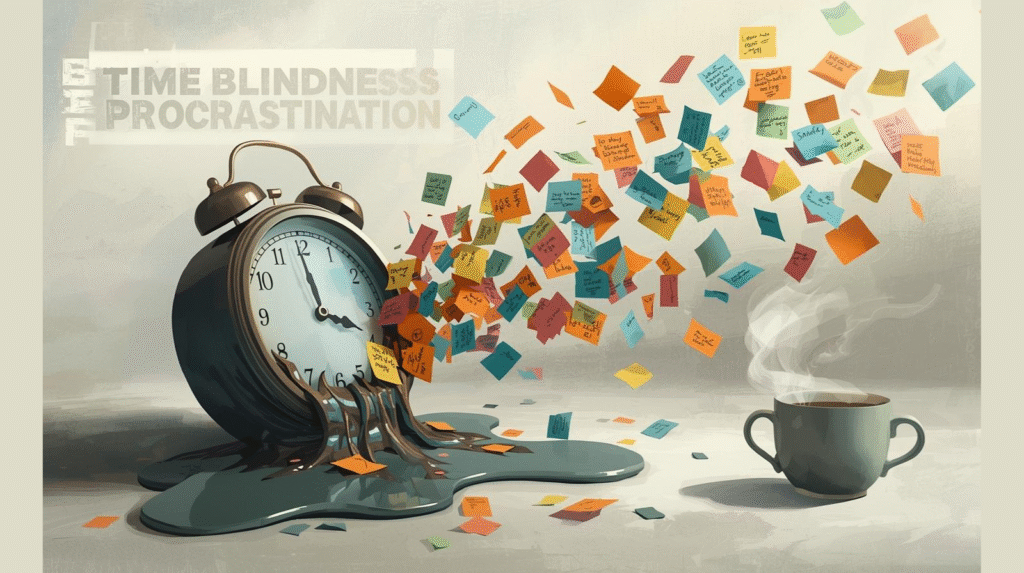
You ever sit down at your computer for a “quick look” at your email, and when you finally look up, the sun has gone down and you’ve somehow missed lunch? That’s not just getting “sucked in.” That’s time blindness.
It’s easy to confuse this with simple procrastination, but let’s get one thing straight: the time blindness vs procrastination debate is settled. They are not the same beast.
Procrastination is a conscious choice. You see the looming deadline, you understand that Friday is three days away, and you make an executive decision to pawn that task off on “Future You.” It’s an act of avoidance.
Time blindness, however, is a problem of perception. With time blindness, “Future You” is a mythical concept. Your brain doesn’t just ignore the passing of time; it fails to feel it. Time isn’t a linear, measurable resource. It’s just a giant, formless pool of “Now” and “Not Now.” That “five-minute” task? It might take five minutes, or it might take five hours. Your brain has no idea which, until it’s over.
If you’re ready to stop guessing where your time goes, check out the Reclaim Your Focus ebook. It breaks down practical systems to make time visible and actually work with your brain.
How ADHD Changes the Way You Feel Time
The difference between procrastination and time blindness is a game-changer. One is about motivation; the other is about wiring.
This is where ADHD time perception enters the chat. For many with ADHD, the brain’s internal clock just isn’t installed. It’s not laziness, and it’s not a character flaw—it’s neuroscience. The part of your brain responsible for sensing, budgeting, and sequencing time is just… operating on a different frequency. Time doesn’t “flow”; it “chunks.” And then, all at once, a deadline that felt a month away is suddenly here, screaming at you in high-definition.
This has a massive, often frustrating, impact on ADHD and productivity. You can’t manage what you can’t measure. This is why you show up 20 minutes late to appointments, convinced you had “plenty of time.” It’s why you start a “simple” tidying session and find yourself, four hours later, cataloging your old book collection in what has become an impromptu archaeological dig.
So, if you’re constantly ambushed by the clock and feel like you’re living in a state of permanent “just a minute,” hear this: You are not broken. You are not lazy.
You just need different tools. You need to make time visible. You need to build the clock outside of your head. This means loud timers (and lots of them), calendars that yell at you, and visual systems that show you, tangibly, where the hours are going. Your brain needs an external co-pilot for time, and that’s perfectly okay.